
30/07/2026
The Bioceanic Corridor: A New Route for Logistics Integration in South America
The mega-project that will connect the Atlantic with the Pacific, transforming logistics and trade in South America
South America is advancing a project that promises to transform its integration into global trade: the Bioceanic Corridor. This mega-project aims to connect the Atlantic and Pacific Oceans by road and rail, traversing Brazil, Paraguay, Argentina, and Chile.
More than just a transport route, it represents a strategic axis for economic development and regional integration.
What is the Bioceanic Corridor?
The Bioceanic Corridor is an ambitious land-based logistics integration network that seeks to connect the Atlantic Ocean with the Pacific Ocean across South America via roads, railways, and port hubs. Currently under development, it crosses Brazil, Paraguay, Argentina, and Chile through a network of roads and port hubs.
The project connects Brazilian ports on the Atlantic coast with Chilean ports on the Pacific coast. The route will pass through the Brazilian state of Mato Grosso do Sul, cross the Paraguayan Chaco, pass through northwestern Argentina, and end at northern Chilean ports such as Antofagasta, Mejillones, and Iquique, establishing a land route of more than 2,400 km between the two oceans. This will allow agricultural, mining, and industrial goods to cross from coast to coast in less time and with lower logistics costs.
It is projected as a land-based alternative to the Panama Canal, which diversifies and decongests trade routes to Asia, North America, and Europe, reducing distances, improving regional connectivity, and boosting the economic development of the countries involved.
Its origins date back to the historic project of the "Capricorn Bioceanic Corridor." However, the current project originated with the 2015 Asunción Declaration, signed by the presidents of Argentina, Brazil, Chile, and Paraguay, to advance regional physical integration through bi-oceanic land corridors.
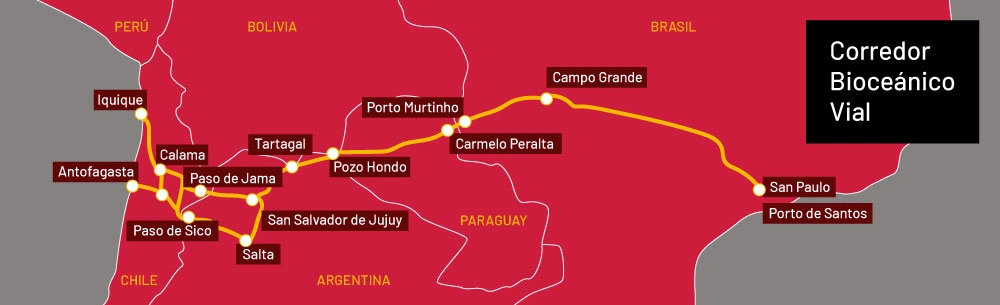
Logistics and Economic Benefits
The Bioceanic Corridor is not merely an infrastructure project, but also a driver of development for the entire region. By enhancing the connection between the Atlantic and Pacific, it unlocks a range of opportunities that directly impact the logistics, competitiveness, and international projection of Southern Cone countries. Key benefits include:
- Reduced Transit Times and Costs: Shortening transit between oceans will directly impact export competitiveness.
- Enhanced Regional Connectivity: This will boost trade among Brazil, Paraguay, Argentina, and Chile, thereby strengthening local economies.
- International Projection: Southern Cone countries will gain more agile access to Asian markets, particularly for agro-industrial, mining, and refrigerated products.
- Port Development: The ports in northern Chile and southeastern Brazil will consolidate as strategic hubs for global trade.
Studies by international organizations estimate that the Bioceanic Corridor could move more than 8.6 million tons annually and generate an economic impact of more than $3 billion, with reductions in logistics costs of up to 30-40% and shorter transit times for goods.
Current Project Status
The Bioceanic Corridor continues to make progress in 2026, with significant milestones in both infrastructure and the facilitation of international trade. One of the main developments is the Bioceanic Bridge between Carmelo Peralta (Paraguay) and Porto Murtinho (Brazil), a strategic project aimed at strengthening the land connection between the two countries. Construction of the bridge is now at an advanced stage, and the physical connection is nearing completion, bringing the realization of one of the corridor’s key integration points one step closer.
In Paraguay, development of Route PY15 continues, which crosses the Paraguayan Chaco and is one of the key sections connecting the bridge to the Argentine border. Progress on these projects is gradually strengthening the infrastructure needed for the corridor to function as an effective alternative for international freight transport.
At the same time, Brazil made progress in implementing the TIR system, a tool that will simplify certain customs procedures and streamline the international transit of goods. This measure represents a significant step forward because it demonstrates that the consolidation of the corridor requires not only physical infrastructure but also mechanisms that facilitate and streamline the movement of cargo between the countries involved.
In this new landscape, the challenge is shifting from infrastructure construction to the coordination of an international logistics operation involving various countries, customs authorities, carriers, and operators.
Complementary infrastructure: Andean passes and connectivity.
The Jama Pass, on the border between Chile and Argentina, is establishing itself as one of the corridor's strategic crossings, offering year-round transit and connecting the routes of northern Argentina with the Chilean road network to the Pacific ports.
At the same time, progress is also being made on the connection between Paraguay and Argentina. The project for a new international bridge between Pozo Hondo, in Paraguay, and Misión La Paz, in Argentina, aims to improve border connectivity and strengthen one of the strategic points for the movement of cargo between the two countries.
Likewise, complementary projects such as the Agua Negra Tunnel between Argentina and Chile, continue to be considered key initiatives for strengthening corridor variants and diversifying trans-Andean connection alternatives, although they are currently still in the planning stages.
An Opportunity for Risk Management
Beyond its commercial benefits, the Bioceanic Corridor also presents new challenges:
- Increased flow of goods on terrestrial routes highly exposed to climatic risks, theft, or accidents.
- Greater need for comprehensive insurance solutions covering land transport, multimodal operations, containers, and civil liability in international logistics operations.
As the corridor moves toward greater operational capacity, these challenges become increasingly significant. The movement of goods across different countries and jurisdictions adds complexity for companies involved in the logistics chain, which must anticipate risks related to cargo damage, route disruptions, accidents, delays, and other contingencies that could affect the continuity of their operations.
In this context, solutions such as Cargo Insurance, Container Insurance or Logistics Operator Insurance gain particular relevance, as they ensure business continuity and contractual compliance in increasingly complex transits.
Looking Towards the Future
The Bioceanic Corridor is more than just a highway: it is a symbol of sovereign integration and of South America's capacity to design its own logistics solutions in the face of transforming global trade.
The progress made in 2026 shows that the project is beginning to enter a phase of greater implementation. The construction of strategic infrastructure and the adoption of tools to facilitate trade point to a future of greater regional connectivity, but also of greater exposure to risks for those involved in foreign trade and logistics operations.
For companies that export, import, or rely on regional logistics, preparedness is key.
At Hanseatica, we support our clients with coverage tailored for each stage of the journey, helping them anticipate risks and seize new opportunities.
Do you want to learn how to protect your operations in this new logistics landscape? Schedule an appointment with our team, and let's design the optimal coverage strategy for your business together.
Related articles

Cadena logística del café: prevención de riesgos desde el origen hasta el puerto
El crecimiento del comercio internacional de café impulsa cadenas logísticas cada vez más extensas y complejas.…
Peru Boosts Exports and Strengthens Its Role in Regional Trade
Peru exported US$35 billion in the first four months of 2026 and is solidifying its position as one of the…

Argentina's Exports in 2026: Growth, Key Sectors, and New Challenges for Foreign Trade
Argentine exports are experiencing strong growth, driven by sectors such as…